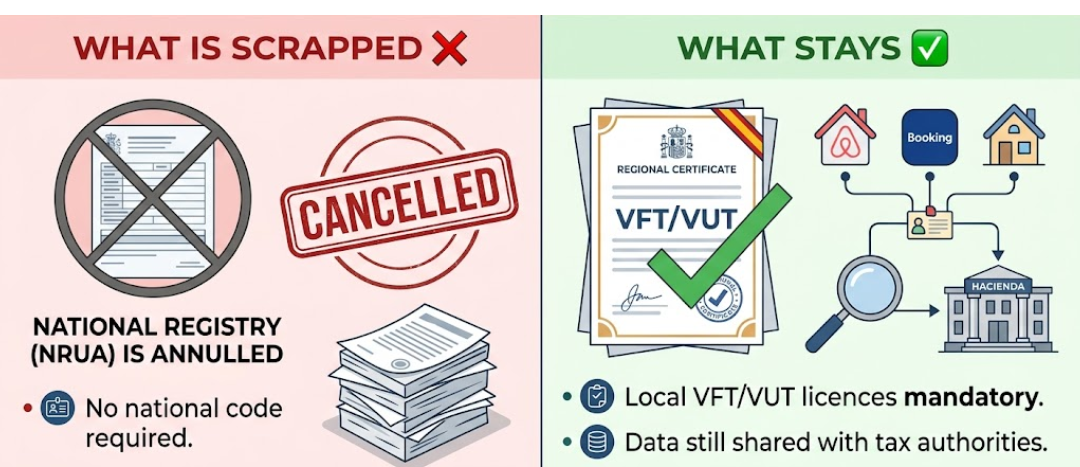
If you are a property owner in Spain leasing out a holiday home, the legal landscape just shifted again. This morning, the Spanish Supreme Court officially struck down the creation of the National Registry for Short-Term Rentals (NRUA) and its mandatory registration requirements. For many landlords, this might feel like a relief one less bureaucratic hurdle to clear and one less annual report to file. Before you completely discard your paperwork, it is crucial to understand what this ruling actually changes and what it leaves intact. At Sun Lawyers, we want to give you a clear, straightforward breakdown of the facts so you can keep your property compliant without the stress.
Why Did the Supreme Court Annul the NRUA?
The core of the issue came down to constitutional jurisdiction. Spain is a highly decentralised country, and the Supreme Court ruled that the central government overstepped its bounds by imposing a national registry on top of existing local laws. Spain’s autonomous communities (such as Andalusia, the Valencian Community, and Catalonia) already govern and maintain their own established registries for tourist properties, the NRUA was deemed an overreach. Simply put: The state cannot force you to register on a national list when your regional government already mandates and manages its own local licence system.
The New Reality: What Stays and What Goes
While the NRUA mandate has been dismantled, the Supreme Court’s decision deliberately left several critical data-sharing mechanisms intact to comply with broader EU regulations. Here is exactly where the law stands for landlords and booking platforms today:
Legal Element |
Current Status |
What is means for property owners |
|---|---|---|
| National Registry (NRUA) | Annulled | You are no longer required to obtain, display, or annually report on a national NRUA code to rent your property. |
| Regional Registries (e.g., VFT/VUT) | Active & Mandatory | You still need your local tourist licence from your autonomous community. This remains strictly enforced. |
| Digital “Single Window” | Active | The centralised digital portal (Ventanilla Única Digital) remains in place for administrative data transfers. |
| Platform Data Transmission | Active & Mandatory | Airbnb, Booking.com, and others must still transmit your rental data to authorities for monitoring and tax purposes. |
What Do Landlords Need to Do Next?
If you are currently letting a property on the Costa Blanca, Costa del Sol, or anywhere else in Spain, ground your next steps in these three realities:
-
Protect your regional licence: Your local tourist licence is your golden ticket. Ensure your regional registration is active, compliant with local community statutes, and clearly displayed on your online listings. Platforms will continue to enforce this.
-
Expect platform monitoring: Because booking platforms are still legally obligated to share data with the administration, any income generated from your rental will remain highly visible to the Spanish tax authorities. Ensure your quarterly or annual tax declarations are accurate.
-
Ignore the NRUA noise: If you were in the middle of trying to figure out the new NRUA annual reporting obligations, you can officially stop. The national mandate is gone.
Keep Your Property Compliant with Sun Lawyers
The laws governing Spanish real estate and short-term rentals are constantly evolving. While the annulment of the NRUA removes one layer of red tape, maintaining your regional licences and tax obligations is more important than ever.
If you are unsure about the status of your local tourist licence, or if you need assistance navigating your tax obligations as a resident or non-resident landlord, we are here to help. Contact the team at Sun Lawyers today to ensure your Spanish property investment remains fully compliant and profitable.