
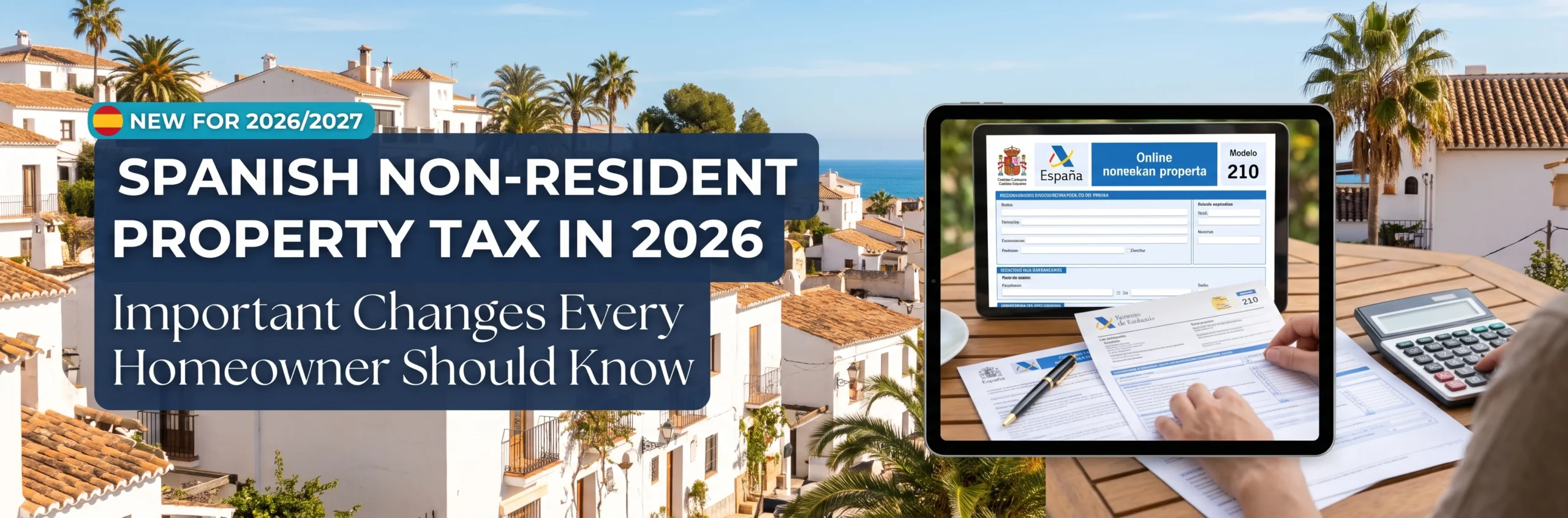
New filing rules for non-resident property owners take effect for 2026 imputed property income, with the first returns under the revised arrangements due in 2027.
If you own a holiday home in Spain and do not rent it out, you may still be liable for Spanish Non-Resident Income Tax (Impuesto sobre la Renta de no Residentes, or IRNR) on imputed property income. This is generally declared using Modelo 210.
A new legislative order, Orden HAC/623/2026, published in Spain’s Boletín Oficial del Estado on 23 June 2026, introduces changes to Modelo 210 and its filing arrangements. These changes are particularly relevant to non-resident owners of Spanish property.
What changes, and when?
The transition is important because the filing arrangements for the 2025 and 2026 tax years differ.
For the 2025 tax year: the existing filing period remains in place. The Modelo 210 return for imputed income relating to 2025 must be filed between 1 January and 31 December 2026.
For the 2026 tax year onwards: the new filing window for imputed income from urban property runs from 1 April to 31 December of the following year. Therefore, the return for the 2026 tax year will be filed between 1 April and 31 December 2027.
The revised Modelo 210 also applies to returns submitted from 1 January 2027, irrespective of the tax year to which they relate.
Property owners should plan ahead, keep their records up to date and check which filing arrangements apply to their particular return.
Understanding imputed property income
One of the most common misconceptions among overseas property owners is that no rental income means no Spanish tax liability.
For non-resident individuals, an urban property kept available for their own use or left vacant can generate taxable imputed income, even when no rent is received.
The calculation generally starts with the property’s valor catastral (cadastral value), rather than its purchase price.
In general, the imputed income is calculated using one of two percentages:
- 1.1% where the cadastral value meets the applicable criteria for a general cadastral valuation revision or determination within the relevant period.
- 2% for other properties.
The precise rate must be checked against the property’s cadastral valuation history and the rules applicable to the relevant tax year. A routine municipal update should not automatically be assumed to qualify.
The resulting imputed income is then subject to the applicable non-resident tax rate. The amount may need to be adjusted for the ownership share and the period during which the property was held or available to the owner.
Garages, storage rooms and separate cadastral references
Some Spanish property purchases include a residential property, a garage and a storage room. These may have separate cadastral references and, in some cases, separate title deeds.
Owners should not assume that every ancillary unit is automatically covered by the declaration for the main residence.
The correct reporting treatment depends on the legal ownership, the cadastral details and the applicable Modelo 210 rules. Where separate units are independently identifiable for tax purposes, their treatment should be checked carefully to ensure that all relevant property interests are accounted for.
Reviewing the deeds, cadastral references and IBI documentation can help identify potential omissions before a return is submitted.
Why accurate property records matter
The new Modelo 210 includes additional fields relating to ownership percentage, the number of days the property was available to the taxpayer or rented, and cadastral-reference information.
These details make it particularly important to ensure that the information used for the return is accurate and consistent with the property’s records.
Rather than relying solely on a previous year’s declaration, owners should check whether there have been changes to ownership, cadastral information, property use or the applicable tax rules.
Incorrect or incomplete declarations can create tax-compliance issues, so professional review may be valuable where a property includes several units, ownership is shared or the cadastral position is unclear.
How Sun Lawyers can help
At Sun Lawyers, we understand that managing Spanish property obligations from overseas can be confusing, particularly when filing rules change.
Our team can assist non-resident property owners with understanding their obligations, reviewing relevant property documentation, checking the information required for Modelo 210 and arranging appropriate tax-filing support.
Where a property includes a garage, storage room or other separately registered unit, we can help review the available documentation to establish the appropriate reporting treatment.
Our aim is to make Spanish property ownership easier to manage by helping clients understand their responsibilities and approach their tax obligations with confidence.
Planning ahead for your next Modelo 210 return
If you own a second home or holiday property in Spain, now is a good time to check your filing position and prepare for the applicable deadlines.
For advice tailored to your circumstances, contact the Sun Lawyers team.
Sun Lawyers
Email: admin@sun-lawyers.com
This article provides general information about Spanish non-resident property taxation and is not a substitute for advice based on an individual property’s circumstances. Filing dates, rates and reporting requirements should be verified for the relevant tax year.